
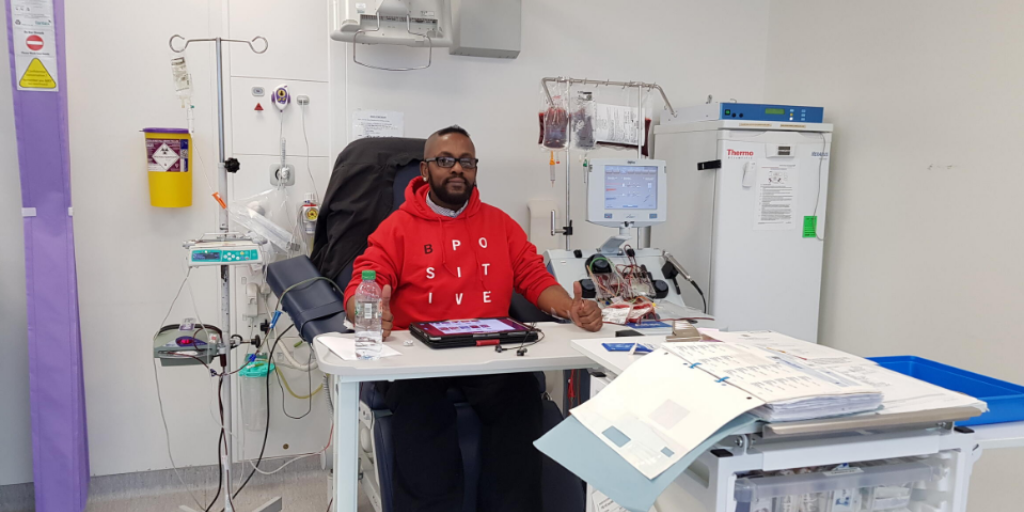
NHS Blood and Transplant is leading on a study using an advanced algorithm to select genomically matched blood to improve safety and make best use of rare blood units.
Whilst NHSBT matches for the major blood groups, some patient groups, particularly those with sickle cell disorder, often form antibodies to the minor blood groups they are exposed to during regular transfusions, which is known as alloimmunisation. This can lead to transfusion reactions and make subsequent transfusions more difficult and higher risk.
The new study promises to leverage extended blood group testing performed using new DNA technology for both donors and patients.
It will use a new algorithm – called bloodMatcher – which incorporates additional minor blood groups into the matching process.
BloodMatcher will be evaluated against blood selected manually using the current policy, where blood is normally only matched for people with sickle cell against four core blood groups.
The feasibility study is led by NHS Blood and Transplant, working with University College London Hospitals NHS Foundation Trust (UCLH) and the National Institute of Health and Care Research (NIHR) UCLH Biomedical Research Centre, with additional funding from NIHR as part of their AI programme.
Following informed consent, researchers will use the algorithm to inform selection of blood for around 40 adult participants who need regular transfusions for sickle cell disorder at UCLH.
The blood is selected based on new, DNA-based genotyping of the donor and recipient’s blood groups, which is faster and cheaper than conventional testing.
All the standard safety checks that are mandated in transfusion practice will remain in place with an additional clinical scientist review as part of the study programme.
The study will pave the way for a larger, multi-centre trial. The study is sponsored by NHSBT and led by operational and clinical teams at NHSBT and UCLH. The funders are NIHR AI programme, NHS Blood and Transplant, and UCLH Biomedical Research Centre. UCLH provides trial management.
Dr Sara Trompeter, Consultant Haematologist for NHS Blood and Transplant and University College London NHS Foundation Trust, who is the clinical lead for the work, said: “Currently, given the numbers of units available and orders to fulfil, it’s not practical to consider many blood types – the blood types are too complex, and the number of units too numerous , for humans to compute the best unit to send.
“This new technology hopes to reduce the potential mismatch between donor and recipient minor blood groups. Mismatches can cause the formation of a blood group antibody (alloimmunisation) which makes it hard to find blood the patient can safely receive or even severe transfusion reactions.
“The population cohort that most struggles with the complications of alloimmunisation is the study population of interest in this study — adults with sickle cell disorder. Around 17% of adults with sickle cell are alloimmunised.
“The new bloodMatcher algorithm will – combined with the new genomic blood data we have available– be able to select units in a faster, far more advanced way. The goal is to improve donor to patient antigen matching and thus reduce the risk of alloimmunisation and the risk of severe transfusion reactions for patients needing blood. By improving matching, we will de facto also reduce ‘waste’, caused by giving valuable rare units to people who don’t need them.”
John James OBE, Chief Executive of the Sickle Cell Society said: “Blood transfusions are an important part of treatment for many people living with sickle cell disorder. But blood needs to be closely matched, otherwise transfusions can become more difficult over time. We welcome this study, which aims to provide blood that is even more precisely matched to the person receiving it.
“For people living with sickle cell, developing complications from transfusions can make treatment more complex and more stressful over time. Research into improving the precision of blood matching could lead to a big improvement in treatment experiences, patient safety and long-term care.”
Notes:
- The feasibility study is part of the overall Haem Match project. Haem Match is a consortium. The funders and collaborators at NHS Blood and Transplant, The Blood transfusion Genomics Consortium, University College London Biomedical Research Centre, NIHR Artificial Intelligence in Health and Care grant, the University of Cambridge, University College London and Sanquin.
- For most red cell transfusion recipients, blood is sourced that is compatible with their ABO and D blood groups. To address the higher prevalence of antibodies in those with sickle cell disorder (SCD), the current standard of care in SCD is to match for blood that is compatible with the recipients ABO, RH (D CcEe) and Kell antigens (Davis et al., 2017). However, despite this additional degree of matching, overall antibody prevalence in SCD patients is around 17% (Trompeter et al., 2020). Our studies (Trompeter et al., 2023), in line with other international data, have confirmed that many patients with SCD continue to develop new antibodies despite these additional matching requirements, suggesting that further matching is needed to mitigate this risk.
- Red cells for transfusion have labels on their surface known as blood groups, of which over 300 blood groups of antigens are currently described. Current practice is to match blood for transfusion to the patient’s antigens, but this is usually only possible for the antigens of the major blood groups, for which donor blood is currently tested. Antigens of the many minor blood groups are usually not matched as the current tests are too expensive. Hence mismatches between the transfused donated cells and the cells of the patients frequently occur. This can cause life-threatening reactions in which the transfused cells are rapidly broken down by antibodies formed by the patient. These make it more difficult to find compatible blood for future transfusions; there may be delays in care or in some cases there may be no compatible blood available.