
AI is everywhere in healthcare. But can clinicians trust it?
Across the UK and Europe, clinicians are operating under unprecedented pressure. Workforce shortages persist, and in primary care alone, GPs now see nearly half of the UK population every month, significantly increasing cognitive load and decision complexity at the point of care. Survey insights show how almost a third of UK clinicians say they don’t have enough time to deliver care, with 74% citing high patient volumes as the primary cause. As medical knowledge expands and patient complexity increases, clinicians are being asked to process more information, make more decisions, and do so faster, often during already compressed consultations.
In this environment, AI‑enabled tools are being introduced to support clinical decision‑making, with the aim of improving speed and access to information. However, for clinicians, usefulness depends not only on efficiency, but on confidence in the information provided. When it is unclear how answers are generated or where evidence comes from, trust can be difficult to establish. In clinical settings, speed alone is not enough—decision support must be accurate, governed, and aligned with standards of care.
Elsevier’s ClinicalKey AI has been designed to support informed decision‑making by prioritising transparency and is developed in line with Elsevier’s responsible AI framework, incorporating formal governance, clinician oversight and safeguards to support accountable use in clinical environments. It combines the company’s 140‑year publishing heritage with traceability features that allow clinicians to see the specific source material behind each response, supporting verification and confidence at the point of care.
Expanded, Evidence‑Based Answers Clinicians Can Verify
Since its most recent update was launched earlier this year, ClinicalKey AI now enables clinicians to move seamlessly from AI‑generated responses to the full clinical evidence behind them, supporting faster validation and greater confidence at the point of care.
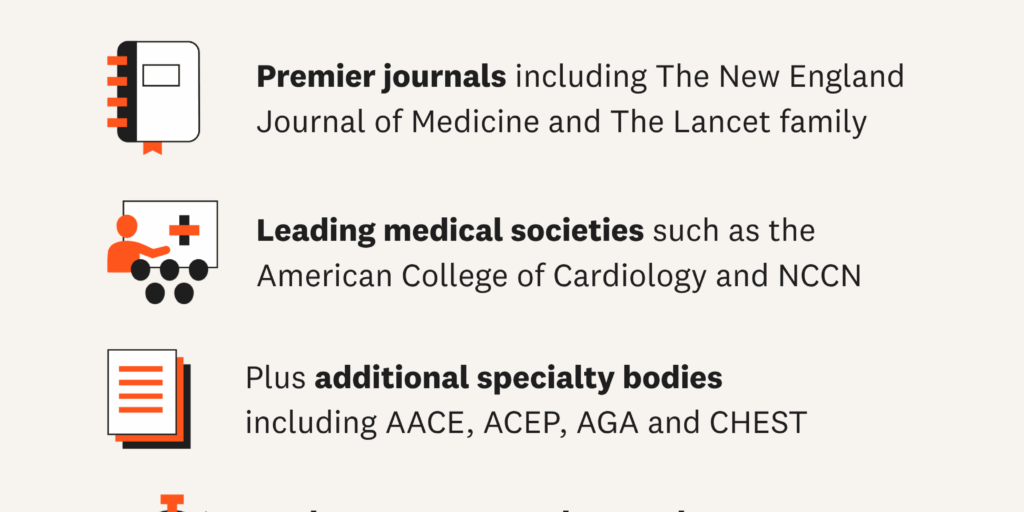
- Full‑text access to 130+ peer‑reviewed medical journals, updated daily
- Direct routing from abstracts to full text via institutional subscriptions
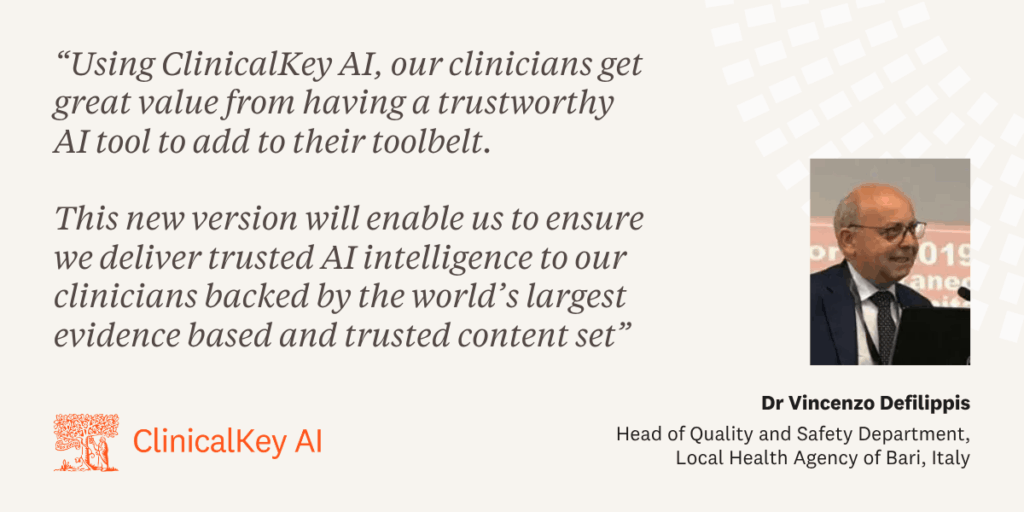
Traceable AI That Shows Its Sources
Rather than presenting opaque outputs, ClinicalKey AI allows clinicians to see exactly where answers come from, helping reduce uncertainty and cognitive bias.
- Paragraph‑level evidence tracing
- Real‑time citation validation
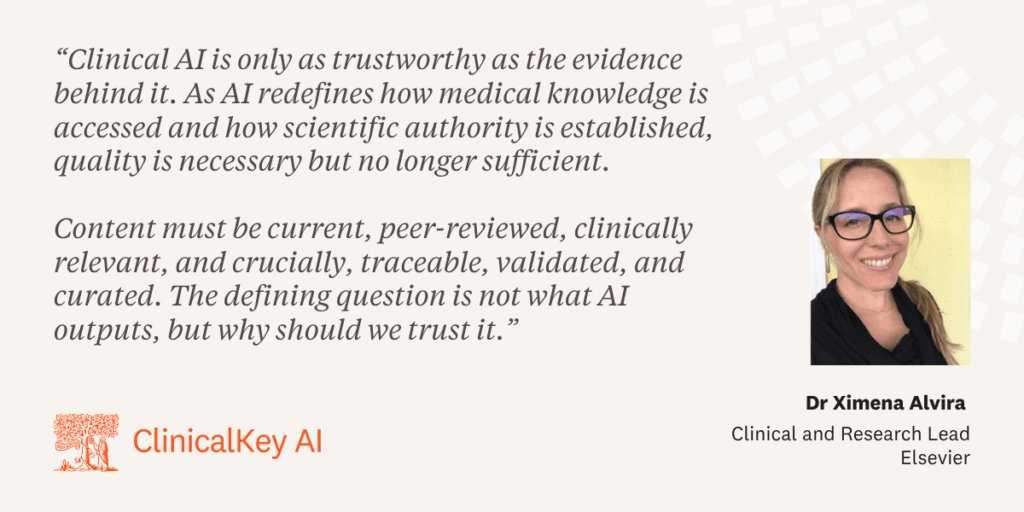
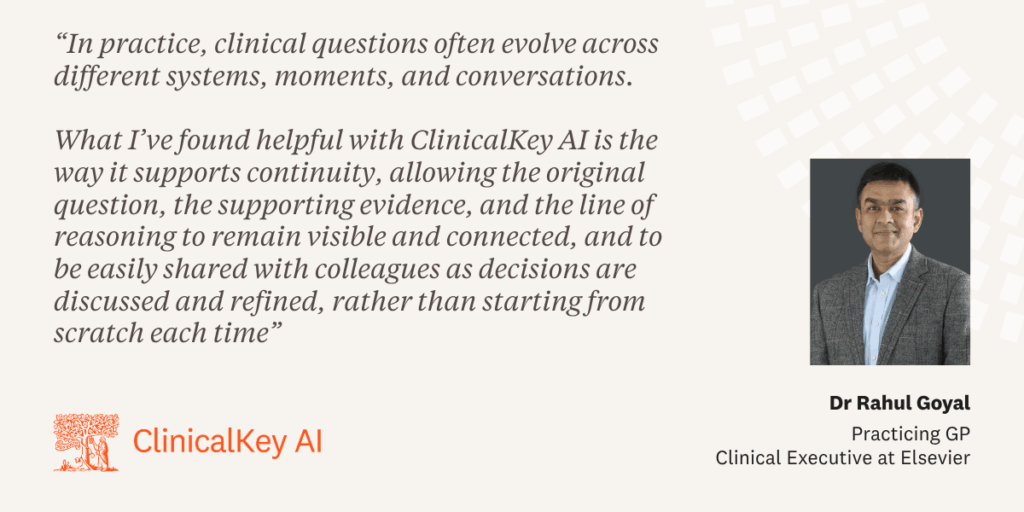
Designed to Fit Real Clinical Workflows
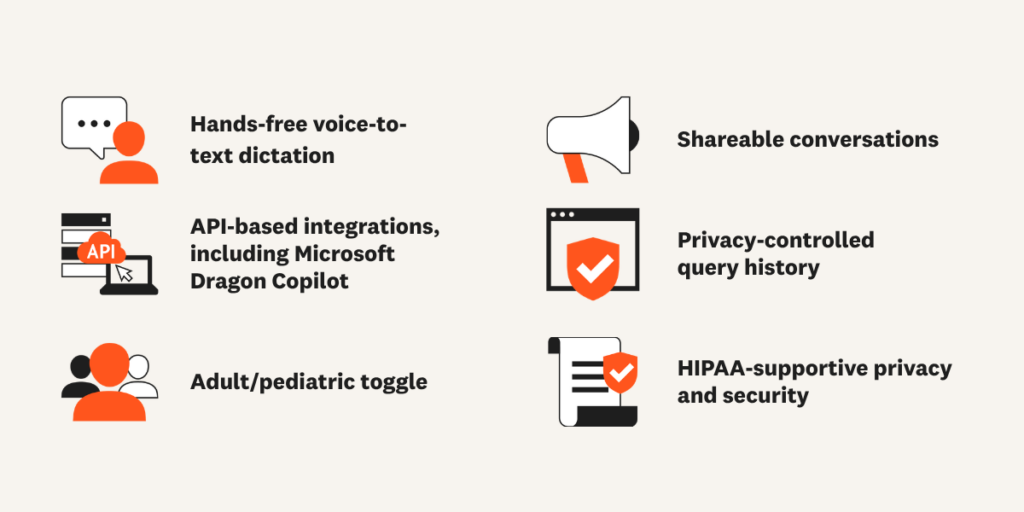
New integrations and usability enhancements mean clinicians can access trusted AI support without disrupting existing workflows.
Integration options are available to support workflow compatibility, subject to institutional configuration.
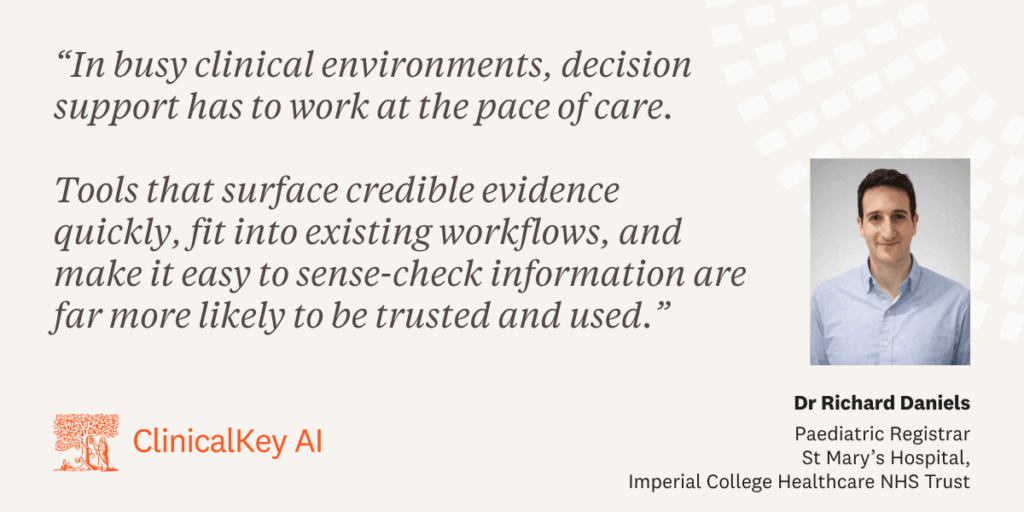
Integration and Usability
ClinicalKey AI fits naturally into daily clinical workflows by meeting clinicians where they are at the point of care. Designed for use in regulated healthcare environments, ClinicalKey AI applies enterprise‑grade security and privacy controls, ensuring clinical queries are handled appropriately and aligned with institutional governance expectations.
For healthcare organisations, this transparency and governance support audit readiness, clinical governance, and responsible AI adoption at scale.
Learn more today
To explore how evidence‑based, transparent AI is being applied in clinical settings, learn more about ClinicalKey AI and its approach to supporting clinical decision‑making, visit https://www.elsevier.com/products/clinicalkey/clinicalkey-ai.