
A new robotic-assisted system that supports early and accurate lung cancer diagnosis, while reducing the need for patients to travel long distances, has been unveiled at Oxford University Hospitals NHS Foundation Trust (OUH).
The Ion robotic-assisted bronchoscopy (RAB) system has been introduced at the John Radcliffe Hospital and will support patients across Oxfordshire and the wider Thames Valley.
Around 150 patients a year are expected to benefit, all of whom would previously have needed to travel to specialist centres in London.
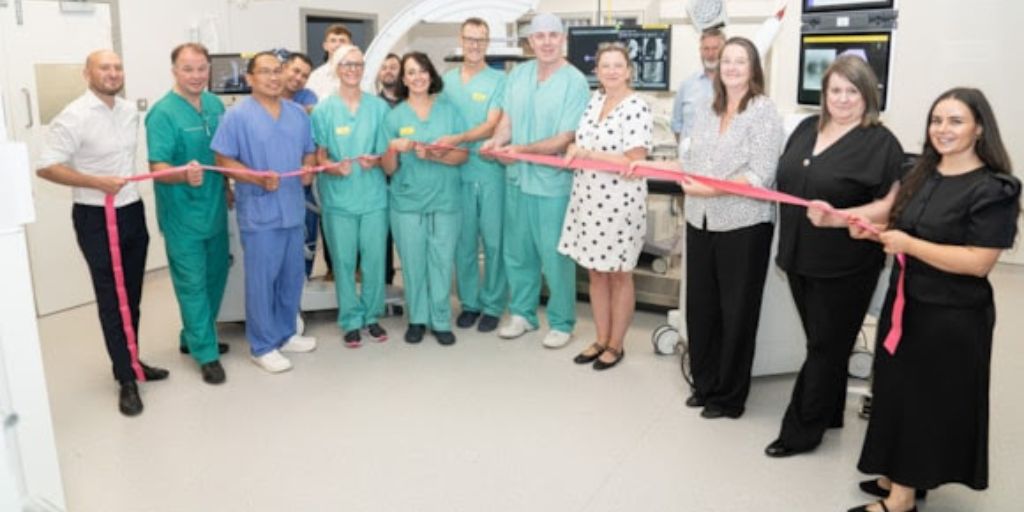
The new technology was officially launched at a ribbon-cutting event attended by clinical teams and Trust leaders, alongside representatives from Intuitive, the makers of Ion, Oxford Hospitals Charity, which funded supporting equipment, and GE HealthCare, which provided supporting equipment.
Ion enables clinicians to navigate a very thin, flexible robotic-assisted tube through the patient’s airways and deep into the lungs, helping them reach small or hard-to-access nodules (lumps). From here, they can take precise tissue samples (biopsies) with high safety and accuracy, to help confirm or rule out a lung cancer diagnosis.
By combining robotic navigation with advanced imaging, it can support earlier diagnosis while reducing the need for multiple procedures. For many patients, this means faster answers, fewer hospital visits and care closer to home.
The system can also be used to mark tumours before surgery, helping surgeons perform more targeted procedures and supporting minimally invasive approaches where appropriate.
Dr Alastair Moore, Consultant in Respiratory Medicine and Lung Cancer at OUH, said: “This technology allows us to safely and accurately biopsy lung nodules that were previously very difficult to reach.
“That means we can diagnose more patients at an earlier stage and with greater confidence, using a single procedure where multiple tests may previously have been needed.
“For patients, it can mean quicker answers, fewer repeat investigations and receiving specialist care much closer to home rather than travelling long distances.”
Linda Gilder, 70, from Didcot, was one of the first patients to benefit from the new technology after being referred following NHS lung cancer screening. Despite feeling fit and healthy, she was shocked to learn she had lung cancer.
The procedure helped clinicians confirm an early lung cancer diagnosis. Linda subsequently underwent surgery and has since been given the all clear.
She said: “I felt a bit nervous but also quite privileged to be one of the first patients to have the procedure in Oxford.
“Everything happened so quickly I still can’t quite get my head around it, from diagnosis to being given the all clear. The care was marvellous and the whole process went incredibly smoothly.”
The introduction of RAB at OUH supports national efforts to improve cancer outcomes through earlier diagnosis. Only a small number of NHS trusts currently offer the technology.
The new system has been made possible through a combination of Trust investment and charitable support. Oxford Hospitals Charity has helped fund essential supporting equipment, including a specialist carbon fibre procedure table, provided by GE HealthCare, that supports the precision imaging required for RAB.
Felicity Taylor‑Drewe, Chief Operating Officer at OUH, said: “We are proud to bring this advanced technology to Oxford and to make it available for our patients.
“We know we have more to do to improve our cancer waiting times and this is an important step in our development plan.
“Earlier diagnosis is vital to improving outcomes for people with lung cancer. This investment will help ensure more patients can access highly specialised diagnostic procedures closer to home and receive answers more quickly.
“It also reflects our commitment to adopting innovative technologies that improve patient experience and support our clinical teams to deliver the very best care.”
Hazel Murray, Head of Programme at Oxford Hospitals Charity, said: “It’s been really exciting to hear what a step forward this robotic equipment is for patients, and we are delighted that the specialist operating table we have funded is also making such a difference. We are so grateful to all our charity supporters whose generosity makes innovation like this possible.”