
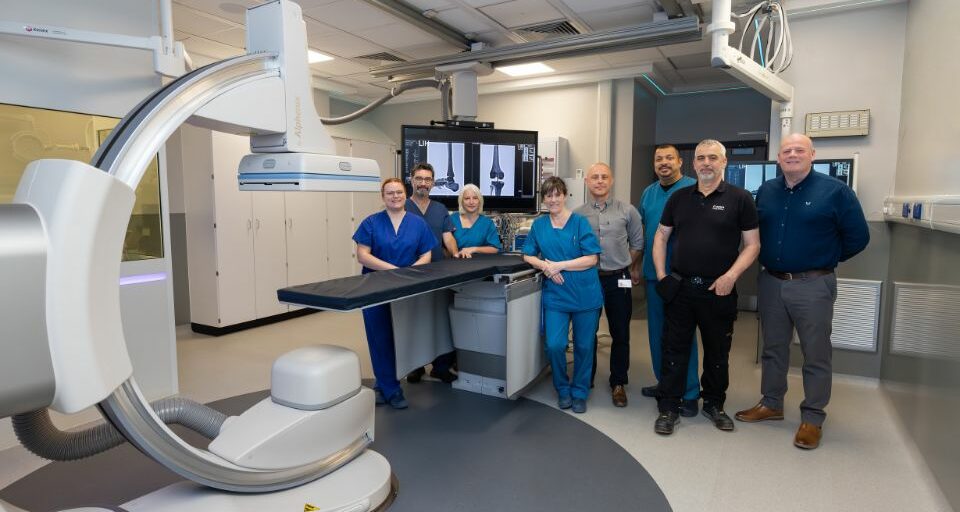
Facing rising demand for minimally invasive procedures and the challenge of delivering specialist care across a largely rural county, United Lincolnshire Teaching Hospitals NHS Trust (ULTH) has strengthened its interventional radiology (IR) service through the installation of two advanced Canon imaging systems.
Together, the Alphenix Core +, with first-of-its-kind HD detectors, and the Alphenix Sky +, will enable ULTH to broaden its IR offering across vascular, urology, and women’s health – helping to reduce hospital stays and speed up diagnoses, enabling more patients to stay closer to home for treatment. Providing greater anatomical detail during scans and reducing the radiation dose administered to patients, the new HD detector technology will support faster, safer, and more accurate procedures for patients across the region.
The investment, which included the complete refurbishment of two imaging rooms, marks a significant step in the Trust’s plans to prepare for future IR demand over the next decade. The Trust is now able to offer modern, patient-friendly imaging environments that support high-quality care and long-term resilience across the Trust.
Expanding complex care at Pilgrim Hospital, Boston
As part of the Trust’s ambition to build an interventional radiology service fit for the future, Pilgrim Hospital in Boston is expanding minimally invasive care with the Alphenix Core +. As the UK’s first installation with HD detector technology, clinicians are now able to visualise complex and intricate anatomy with an unparalleled level of detail.
Mark Dorn, Operational Manager at Pilgrim Hospital, Boston, said, “The HD detector technology is a real step forward for our service. It lets us see in greater resolution and faster, which can streamline diagnoses and procedures, and improve patient outcomes. Alongside advanced imaging technologies like cone-beam CT (CBCT), Needle Guidance, and Spot ROI, clinicians can perform more precise interventions. It also opens the door to more advanced procedures like needle-free stent placements and image-guided biopsies to further support patient safety and recovery.”
This technology is particularly beneficial for patients with kidney and high-risk cardiovascular conditions, along with other complex health needs, where minimising exposure to contrast agents and radiation is critical for patient safety and recovery. By improving precision and confidence during procedures, the system supports more consistent outcomes and reduces the likelihood that patients need to be referred outside the county for specialist intervention.
Flexible technology to support care at Lincoln County Hospital
At Lincoln County Hospital, the focus was on creating a flexible and efficient environment that can adapt as demand grows. The new ceiling-mounted Alphenix Sky + system supports services within the Trust by improving room accessibility and enabling smoother clinical workflows.
Its advanced C-arm design provides full body 3D imaging, allowing the system to move around the patient rather than repositioning the patient during procedures. This can help reduce disruption and improve comfort – especially for those with mobility or complex needs.
The system includes Canon’s latest software, providing a shared interface with the Alphenix Core + system at Pilgrim Hospital, Boston. This unified platform allows clinical teams to move easily between sites without relearning controls or settings – simplifying day-to-day operations, reducing training burden, and ensuring consistency – regardless of location. Memory presets and intuitive workflows also help streamline setup, allowing teams to replicate preferred configurations quickly and reduce the time between procedures, supporting a more flexible and efficient service.
Built for the future
As IR needs change and evolve over time, the Alphenix platform is also designed to adapt to future clinical developments, giving teams the confidence to meet changing service demands in the future. Thanks to ongoing applications and service support through Canon Medical’s Applications for Life programme, the team at ULTH is equipped to get the most from the systems both now and in the years ahead.
Mark Dorn concluded, “I’m excited about where the new technology from these systems can take us. We’re now in a position to offer a greater range of procedures, improve wait times, and keep more patients local rather than referring them elsewhere. For patients across Lincolnshire – particularly in rural and socially deprived areas – this is a real game-changer. It means people can access advanced treatment without long journeys, and with the support of their families close by. It’s a meaningful step forward in delivering high-quality care where it’s needed most.”