
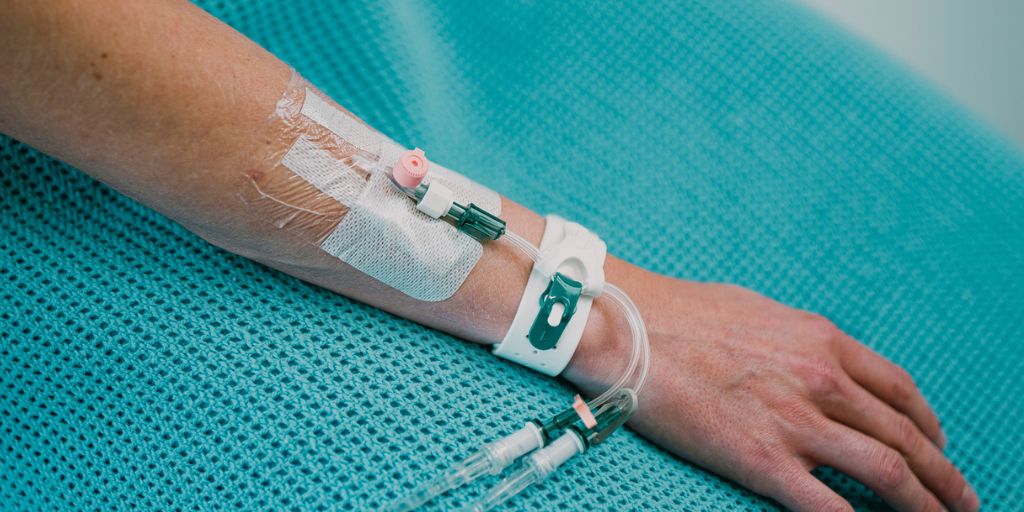
A British-developed device designed to prevent complications associated with poorly secured intravenous (IV) lines has been adopted by NHS hospitals following successful clinical pilots.
Created by Scottish medtech start-up Javelo, the UKCA-marked device is worn like a wristwatch and holds IV lines securely in place during treatment. The device aims to reduce the risk of lines becoming dislodged, blocked or leaking, while giving patients greater freedom of movement and confidence throughout their infusions.
It has also been independently evaluated by researchers at Imperial College London. A comparative study found it to be the most comfortable and effective IV line securement product tested, with the findings published in the peer-reviewed journal PLOS ONE.
More than 15 million patients receive IV therapy in the UK every year. However, complications associated with IV lines can affect up to one in two patients and contribute to the NHS using more than 40 million cannulas annually.
One of the most serious complications is extravasation, which occurs when medication leaks into the surrounding tissue, often following the displacement of an IV cannula. In severe cases, this can cause pain, tissue damage and long-term injury. NHS Resolution has settled more than 200 related claims over the past decade, at a cost of approximately £16 million.
Javelo was founded by Dr Ashton Barnett-Vanes, a medical doctor and PhD graduate of Imperial College London, after he witnessed the challenges of IV line management first-hand while working in NHS hospitals.
Recognising the impact that poorly secured lines can have on patients and healthcare professionals, he set out to develop a more secure, comfortable and practical solution for everyday clinical care. An Enterprise Fellowship from the Royal Society of Edinburgh enabled him to focus on developing the technology.
Dr Ashton Barnett-Vanes, Founder and CEO of Javelo, said:
“Javelo was inspired by a challenge I encountered regularly in clinical practice. Many of the skills needed to identify, develop and evaluate solutions came from my time at Imperial, where people from different disciplines worked together to solve complex problems.
“That approach has stayed with me and become central to my journey as an entrepreneur. Having worked with Imperial researchers to evaluate our first device, it is incredibly rewarding to now see it being used in NHS hospitals.
“We are excited to build on this progress and support patients across a range of therapy areas.”
Dr George Morgan, Research Associate in Imperial College London’s Department of Bioengineering and lead author of the PLOS ONE paper, said:
“This study developed an evaluation method that better reflects the conditions patients experience in clinical practice.
“It has been encouraging to work with innovators such as Ashton and the team at
Javelo, who have subjected their technology to rigorous testing and peer-reviewed publication. This contributes to the evidence base and supports continued improvement across the field.”
During his time at Imperial, Dr Barnett-Vanes was based at the National Heart and Lung Institute, where he was supervised by Professor Sara Rankin; and undertook his doctoral research at the Centre for Blast Injury Studies, where clinicians, engineers and scientists worked together to address complex healthcare challenges.
Professor Sara Rankin of Imperial College London said:
“Ashton’s journey demonstrates how bringing together expertise from different disciplines can equip clinicians and scientists with the skills needed to create practical solutions to real healthcare challenges.
“It is exciting to see an innovation shaped by that approach now delivering benefits for patients and healthcare professionals in the NHS and beyond.”
The UK-manufactured device is being used at a number of NHS sites including Mount Vernon Cancer Centre and Lister Hospital managed by East and North Hertfordshire Teaching NHS Trust; and the Macmillan Renton Unit, located at Hereford County Hospital managed by Wye Valley NHS Trust.
Now in its fourth generation, the device is being made available to healthcare providers nationwide through award to the NHS Supply Chain IV Cannula and Associated Products Framework commencing April 2027.
Javelo is supported by Adjuvo – an angel investment syndicate backing early-stage British companies, Kidney Research UK, Scottish Enterprise and Old College Capital, the University of Edinburgh’s venture investment fund.
For more information, visit www.javelo.health.